 交通
交通 


何氏眼科
SHENYANG HE EYE HOSPITAL


 全国眼健康咨询电话024-76130120
He Eye Specialist Hospital and HelpMeSee have joined hands to embark on an innovative journey in the field of ophthalmic surgical education.
Medicine is a rapidly advancing discipline, with knowledge constantly evolving and new technologies emerging, yielding inspiring achievements. Phacoemulsification surgery serves as a prime example, bringing significant progress to ophthalmology and contributing to societal well-being. The path to becoming a skilled physician is long and challenging, and the importance of continuous learning cannot be overstated. Phacoemulsification is not only a crucial starting point in ophthalmic training but also a skill that requires constant refinement throughout one's professional career. In the past, limited clinical training resources greatly hindered the growth of doctors. However, today, HelpMeSee has successfully overcome this resource constraint by providing an advanced simulation training platform that opens endless possibilities for thousands of aspiring individuals. Join us today and soar to new heights together!
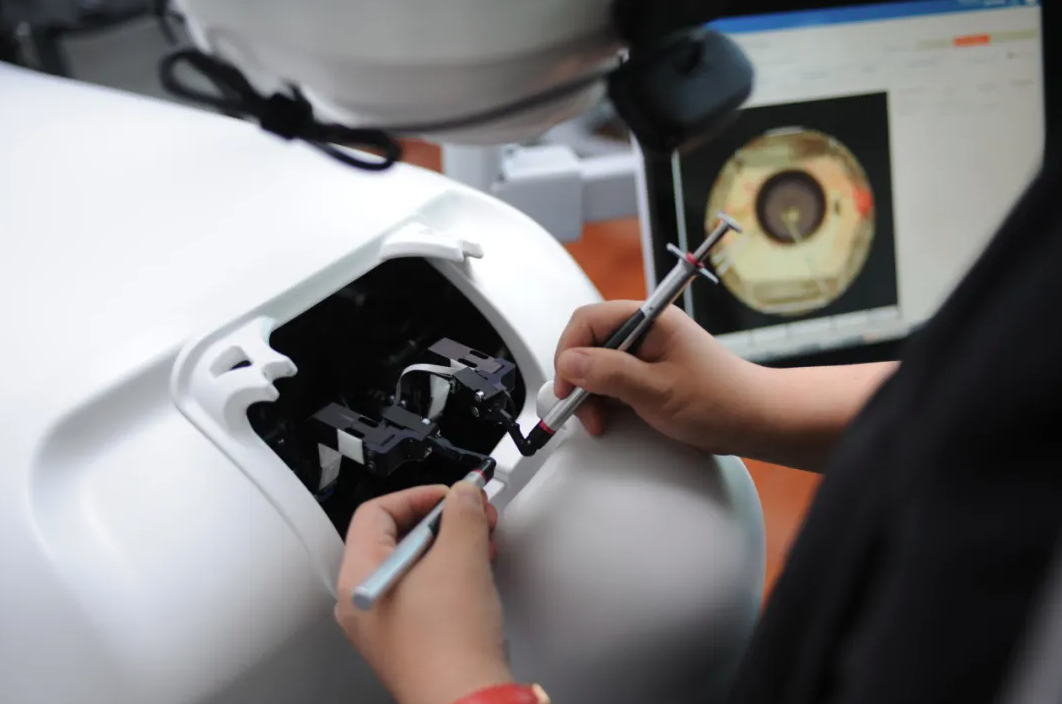
Expected Learning Outcomes:
1. Zero-based beginners: Establish a solid foundation of knowledge, skills, and thinking in real-world surgical learning, enabling a high starting point for clinical surgical training.
2. Practicing surgeons: Reevaluate oneself in the virtual surgical world, rectify erroneous surgical concepts and habits within a limited time, acquire new ways of thinking, master new skills, and enhance the ability to serve patients.
Training Course Overview:
The simulation training includes online self-study, pre-course assessments, interactive classroom teaching, simulator skill exercises, periodic (module) skill assessments, and final evaluations. Through this comprehensive training process, participating doctors will significantly enhance their cognitive level, skill level, and thinking approach in ophthalmic surgery.
1. In-depth Knowledge Exploration: Utilize translated and bilingual versions of HelpMeSee electronic textbooks and slide presentations. The expert surgical team and teachers from Hoya Ophthalmology will work together with the participating doctors to deeply analyze the fundamental knowledge of phacoemulsification surgery, strengthen the connections between knowledge points, and establish a solid cognitive foundation. This ensures that the participating doctors not only know the "what" but also understand the "why."
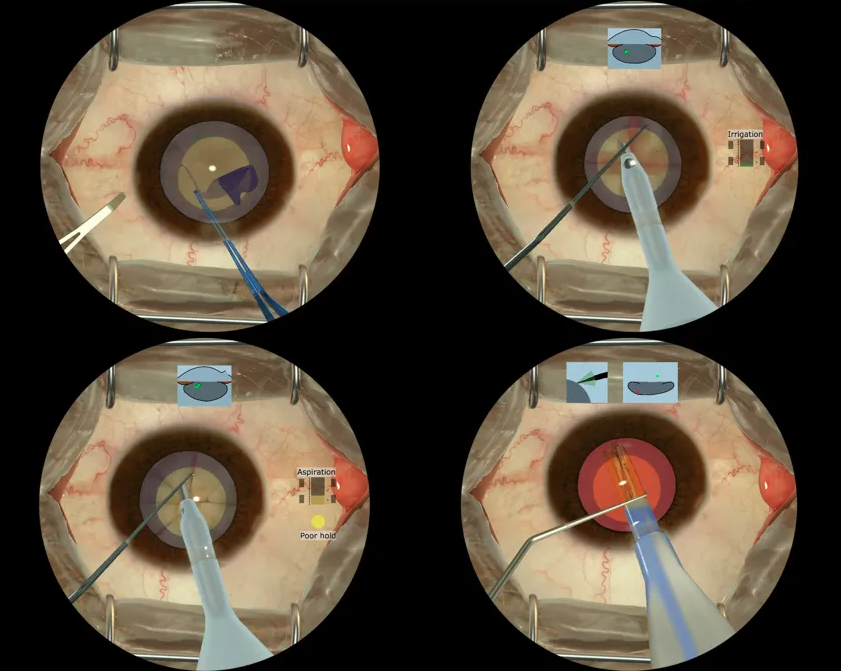
2. Surgical Reinforcement Training: Utilize the comprehensive and realistic HelpMeSee ophthalmic surgical simulation training platform. In an immersive environment, under the guidance of experienced surgical experts and simulation instructors, reinforce surgical skills training. Practice key surgical steps such as phacoemulsification incision creation, continuous circular capsulorhexis, hydrodissection and multilayer separation, lens nucleus fragmentation and emulsification, cortical removal, implantation of foldable intraocular lenses, and wound hydration. The training progresses gradually, starting with step-by-step exercises guided by training tools and gradually transitioning to completing surgeries within modules. This ensures that the participating doctors can apply what they have learned and integrate knowledge with practice.
3. Careful Guidance by Instructors: The course instructors have undergone teaching skill training and certification from the international organization HelpMeSee. They will apply adult learning theories to guide the training in a manner that aligns with the characteristics of adult learners. Emphasis will be placed on fostering critical thinking, encouraging self-reflection, and stimulating active learning. Continuous attention will be given to the progress of the training, providing immediate feedback and personalized guidance. The instructors will not only focus on the objective surgical outcomes of the participating doctors but also pay special attention to details such as instrument handling, surgical techniques, surgical decision-making, procedural adjustments, and handling unexpected situations. A combination of objective simulator assessments and subjective instructor evaluations, along with periodic and summative evaluations, will facilitate the rapid mastery of surgical skills and thinking by the participating doctors. Tailored instruction based on individual strengths and weaknesses will ensure efficient progress and rapid improvement in areas of skill deficiency.
4. Strengthened Group Communication: In a small-class setting, in-depth discussions with cataract surgery experts will cover all aspects of phacoemulsification surgery, fostering academic exchanges and broadening the medical perspective. Through group discussions and interactive dialogues among classmates, the sharing of learning experiences will be promoted. Different perspectives and progress will be explored to understand phacoemulsification surgery from various angles and to collectively discover solutions to problems. Under the guidance of the instructors, self-analysis and mutual analysis will be encouraged, allowing for reflection on the progress of surgical skills training and laying the foundation for self-directed learning in future professional careers. This approach aims to cultivate a habit of self-reflection and integrity in seeking the best solutions for others.
Phacoemulsification is a complex and delicate surgery in the field of ophthalmology, requiring a high level of proficiency from eye surgeons. It not only demands excellent surgical skills but also exceptional clinical thinking, intraoperative judgment, immediate decision-making abilities, and a stable psychological disposition.
In a clinical training environment, patient safety is always the primary concern for instructors, which can create significant pressure when simultaneously focusing on teaching the surgery itself. In contrast, in a simulation training environment, instructors can fully devote themselves to surgical training, providing more detailed guidance, facilitating real-time communication, and fostering interactive discussions between instructors and trainees.
Within the small group setting of simulation training, participants have the opportunity to observe and reflect on each other's surgeries, engaging in mutual analysis. This environment also helps trainees develop their psychological resilience. The advantages of simulation training extend beyond these points. The European Society of Cataract and Refractive Surgeons (ESCRS) has recognized the value of simulation surgical training by including it as a mandatory course for ophthalmology residents.
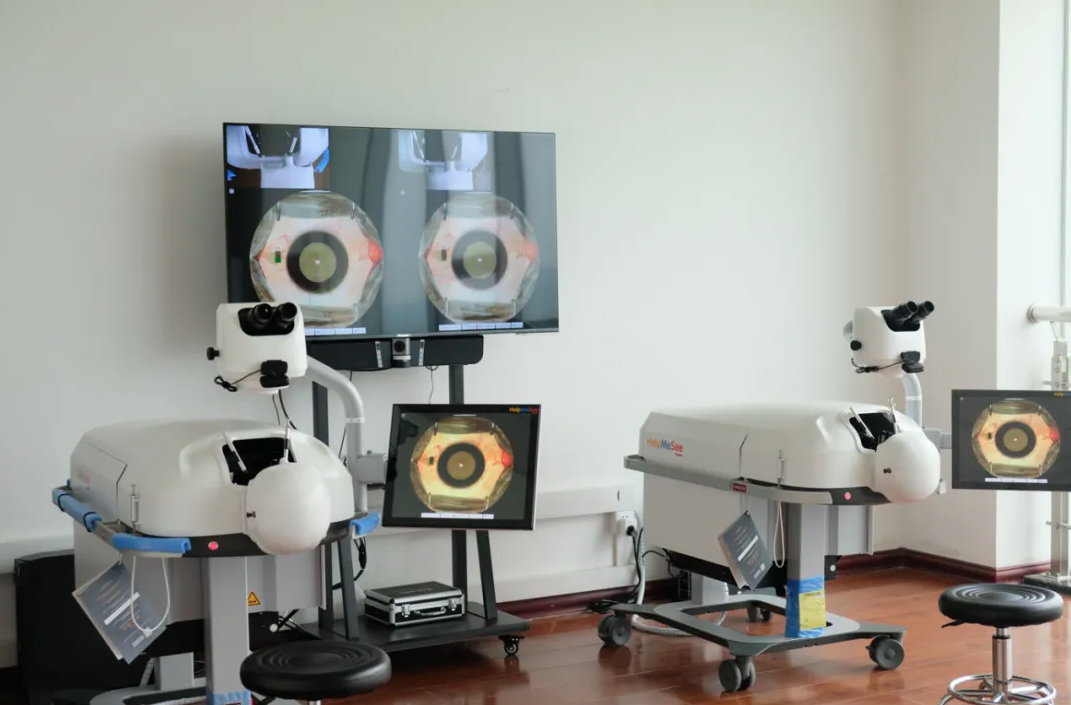
HelpMeSee is an international organization dedicated to training eye surgeons and addressing the escalating global issue of preventable blindness. Guided by the principle of "teaching a man to fish," HelpMeSee aims to train a greater number of eye surgeons to alleviate the global burden of avoidable blindness.
The HelpMeSee eye surgical simulation platform surpasses previous technological limitations by faithfully recreating surgical scenarios. Taking phacoemulsification simulation surgery as an example, it not only replicates the real-time microscopic view but also simulates the various audio information from the phacoemulsification machine. Most importantly, it accurately reproduces the mechanical relationship between surgical instruments and ocular tissues, providing learners with realistic tactile feedback. The significance of tactile sensation during surgery is well recognized by experienced surgeons. The HelpMeSee simulation training platform enables comprehensive training of learners' visual, auditory, manual, and proprioceptive perception, motor skills, and coordination, making it invaluable for surgical education.
The training advantages of HelpMeSee extend beyond the simulation training platform. The organization incorporates successful teaching methodologies, competency certification systems, and training management systems from FlightSafety International, further distinguishing its programs. In addition to providing comprehensive phacoemulsification training, HelpMeSee's simulation training platform also offers training for small incision cataract surgery (MSICS) and other surgical procedures, forming a complete solution for cataract surgical training.
In June 2012, He Eye Specialist Hospital was designated by the National Health Commission of China as a training base for the prevention and treatment of blindness. Since its establishment, the training base has provided training for over 50,000 individuals in ophthalmic surgery, optometry, public health, and other related fields. Trainees have come from various regions, including Guizhou, Inner Mongolia Autonomous Region, Gansu, Henan, Jilin, and Shaanxi. He Eye Specialist Hospital also trained the first cataract surgeon for Heshui County People's Hospital in Gansu. In 2019, under the auspices of the National Health Commission's training base for the prevention and treatment of blindness, the He Eye Specialist Hospital International Training Academy was established. The academy comprises the Optometry Training Center and the Clinical Ophthalmology Training Center, aiming to integrate domestic and international resources and create an internationally leading innovative training platform to cultivate ophthalmologists with international diagnostic and treatment capabilities.
© 2011 - 2019 铁岭何氏眼科医院版权所有 tl.hsyk024.com | 辽ICP备11001860号-1
